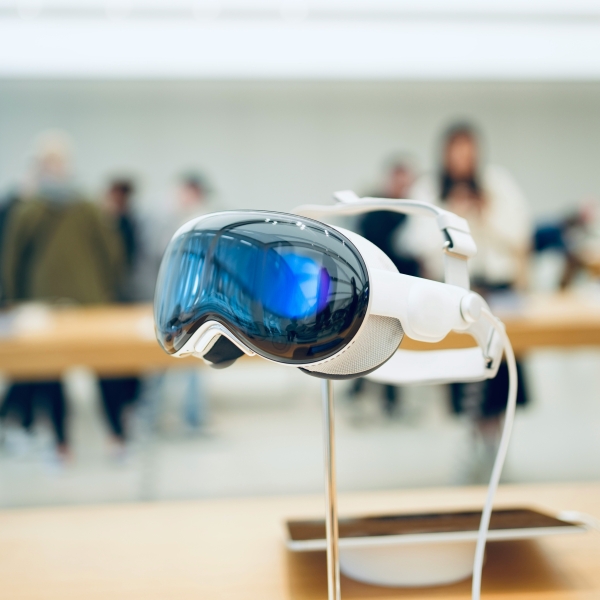
Extended Reality (XR) brings together three major technologies: Virtual Reality (VR), which immerses us in fully digital environments; Augmented Reality (AR), which overlays digital elements onto the real world; and Mixed Reality (MR), which combines both to enable real-time interactions. Together, these innovations are transforming the way we design, collaborate, and interact by blending the physical and virtual worlds.
VR is total immersion in a virtual world
Virtual reality allows you to experience unique moments, whether for training, virtual tours, or video games. This technology immerses you in fully digital environments.
Virtual reality offers a wide range of use cases. In training, it enables immersion in high-risk situations for more effective learning, as demonstrated by our “Professional Fire Simulator” project, which places learners in a workplace fire scenario, requiring them to adopt the right reflexes and follow appropriate procedures. In the real estate sector, virtual reality makes it easier to explore apartments or spaces, whether before construction through 3D modeling or afterward through photogrammetry.
VR provides a complete and impactful immersion into your brand’s universe. It delivers a unique, tailor-made experience where the only limit is your imagination.
At STRATEGIA, we create products designed for Virtual Reality, such as “Les Mondes Virtuels” by STRATEGIA.Lab. This shared experience, accessible directly through a web browser, is an excellent example of VR used for both entertainment and professional purposes, including training, meetings, and education.
Among the leading players in the hardware market are major companies such as Meta with its Quest headsets, HTC with its Vive headsets, and Sony with PlayStation VR. Other smaller competitors are also present, including Bigscreen and Pimax.
AR enriches the real world with digital information
By overlaying virtual elements onto the real world through a screen (smartphone, tablet, connected glasses), augmented reality creates an enhanced and interactive experience. The amount of visible information is therefore “increased”: users perceive not only real-world elements but also additional digital information. Unlike virtual reality, AR does not immerse users in a fully digital environment; instead, it blends the physical and digital worlds.
Augmented reality is used across many fields, from education and interactive marketing (such as Snapchat and Instagram filters) to sports analysis. In Industry 4.0, AR headsets provide operators with critical contextual information, such as equipment lockout status or the type of fluid flowing through a pipe. The military sector also uses this technology, for example through HoloLens headsets for infantry, providing mapping, tactical assistance, and targeting support.
Among the leading players in the market are Microsoft and Magic Leap for advanced professional applications, with real-world use cases that increase the amount of information available to employees in the field, as well as Android and iOS platforms for more consumer-oriented applications.
MR combines the best of VR and AR, creating an experience where the real and virtual worlds seamlessly blend together.
Mixed Reality (MR) allows you to remain in your physical environment while interacting with virtual objects. Unlike Augmented Reality (AR), where digital elements are simply overlaid onto your view of the real world, MR enables these elements to be anchored and interact with the surrounding environment.
Mixed Reality offers many use cases. In architecture and design, it allows architects to visualize, modify, and interact with 3D building models directly on construction sites, providing a better understanding of how a project integrates into its real-world environment. Another example is the extension of digital workspaces: an MR headset can expand a computer’s display area by creating multiple virtual screens, improving the comfort and efficiency of work, even when using a laptop.
The leading headsets in this segment include Meta’s Quest and Apple’s Vision Pro. These devices offer an immersive experience while maintaining interaction with the outside world by integrating virtual elements into the physical environment.
In summary, Mixed Reality makes it easier to visualize and interact with virtual environments in real-world contexts, whether for architectural design, collaboration, or enhanced digital productivity.
Why adopt XR in your processes?
Selecting XR tools tailored to your needs
At STRATEGIA, we help you choose the XR tools best suited to your specific needs, your environment, and the message you want to deliver to your users.
A revolutionary training solution
We leverage XR to provide immersive and engaging training experiences. Through realistic Virtual or Mixed Reality simulations, your teams can train in a more interactive and practical way, improving both understanding and knowledge retention.
Fast and efficient prototyping
With XR, collaboration reaches a new level. Adjust your prototypes in real time and work with your teams in immersive environments to increase efficiency throughout the product design process.
Future opportunities and customer immersion
With XR, immerse your customers directly in your brand universe, providing them with a concrete and interactive vision of your products and services. This strengthens engagement and creates memorable experiences. XR also enables real-time adjustments based on feedback from your teams and customers during the design process.
Since 2007, STRATEGIA has been supporting companies in their digital transformation by creating tailor-made immersive experiences. Adopting XR allows you to take innovation and efficiency to the next level.
Of course, we are ready to explore new use cases, including those that do not yet exist! As an innovative company, we are always excited to apply our expertise to unique projects and push the boundaries of what is possible.